| Data
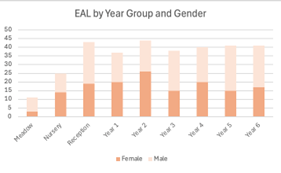
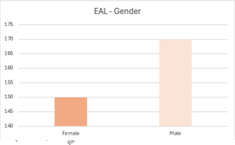
Total Number of children on register = 320 (69.6% - NA 20%)
PP – 81 (25.3%)
Regular interpreters – 2 children
|
High Quality Teaching and Support
Clear modelling of spoken and written language
Visual aids, images and real-life objects to support understanding
Pre-teaching and explicit teaching of key vocabulary
Opportunities for structured talk and collaborative learning
Use of scaffolds such as sentence starters, word banks and writing frames
Checking understanding regularly and adapting explanations where needed
|
|
Identification and Interventions
Children with EAL are identified during the school admissions process. A member of the SLT conducts the admissions meeting with the child and their family, during which information about the languages spoken at home is gathered. Where English is not the child’s first language, this is recorded on the school’s system, and the child is identified as having EAL.
The Head of Inclusion ensures that interpreters are arranged when required so that both children and parents can fully participate in the admissions meeting and any subsequent discussions. This supports clear communication and helps the school gain an accurate understanding of the child’s language background and needs.
|
Assessment
The Bell Foundations framework help us to understand how well a pupil can use English across speaking, listening, reading and writing.
Teachers assess pupils using the Bell Foundation EAL Assessment Framework descriptors.
Judgements are based on ongoing classroom evidence rather than a single test.
Levels are reviewed termly, as pupils’ language proficiency develops.
The information helps staff plan targeted support and monitor progress.
|